
User Onboarding Best Practices: Get to Value Faster
Most SaaS onboarding fails the same way — it explains the product instead of getting users to value. Here are the onboarding practices that actually reduce drop-off, with concrete examples.
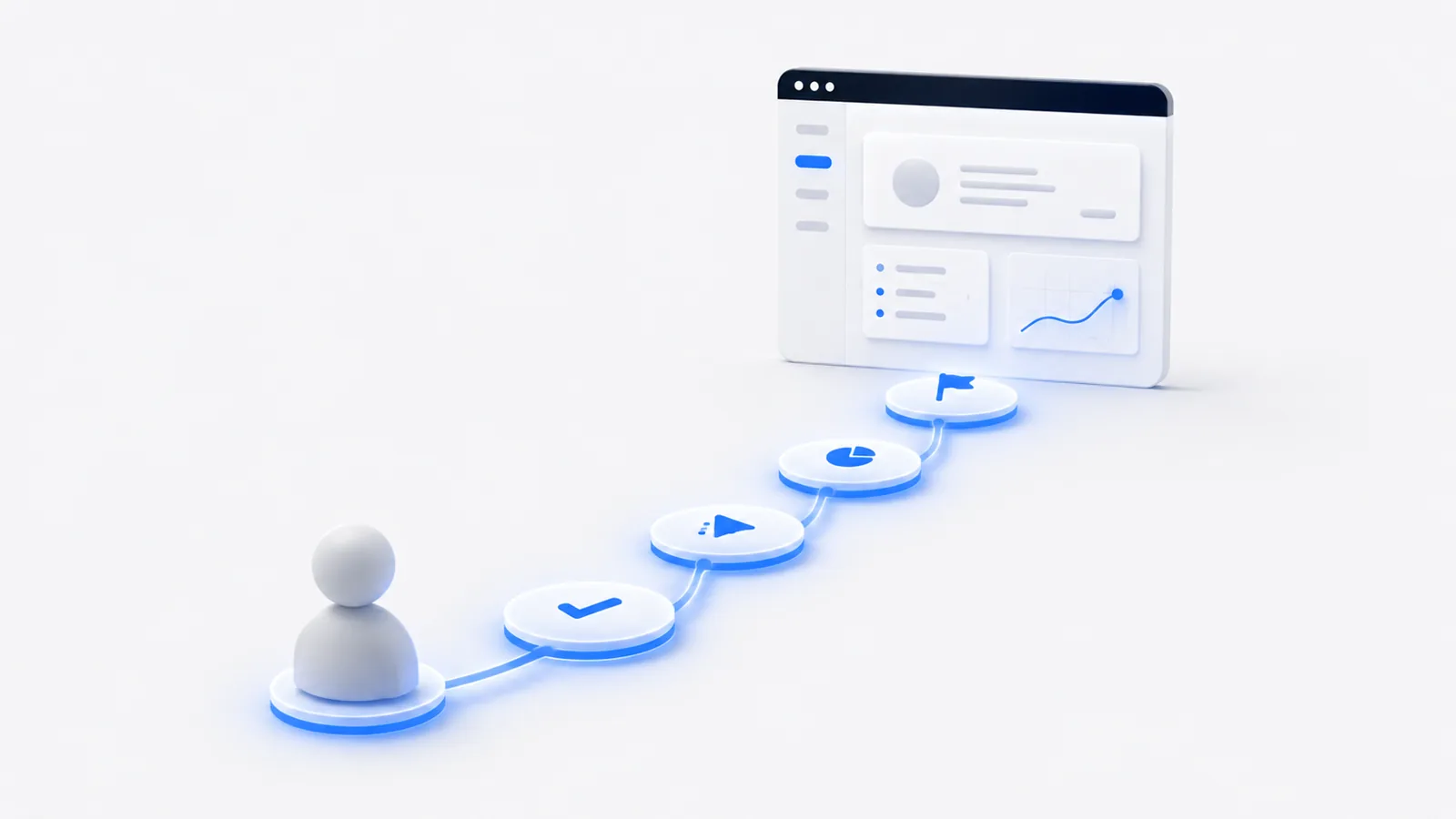
Most onboarding flows make the same mistake: they treat a new user like a student who needs a lecture, when what the user actually wants is to get the thing done they signed up to do. The best onboarding gets out of the way fast and gets people to value. Here's what that looks like in practice.
Define "activated" before you design anything
You can't improve onboarding you can't measure, and you can't measure it until you've defined the activation moment — the specific action that reliably predicts a user will stick around. For a design tool it might be "published a first project." For an analytics tool, "connected a data source and saw a chart."
Write yours down. Every onboarding decision is then judged by one question: does this get the user to that moment faster?
If your team can't agree on the single activation moment, that's the most valuable thing this exercise will surface. Resolve it before touching the flow.
Show value before you ask for setup
The fastest-dropping onboarding flows front-load configuration: connect this, invite your team, set your preferences. Every one of those steps is a wall between the user and the value they came for.
Flip the order. Let people see and feel the payoff first, using sample data or a guided walkthrough, then ask them to set things up once they're convinced it's worth it. Motivation to configure goes up dramatically after the "aha," and craters before it.
Guide by doing, not by touring
A tooltip tour where the user clicks "Next" five times teaches almost nothing — people tune it out. An interactive walkthrough, where the user performs the real action with a little guidance, does two things at once: it teaches, and the action itself is the activation event.
This is where an embedded interactive demo earns its place inside the product: it can carry a brand-new user through the exact happy path, hands-on, without a support rep.
Reduce, then reduce again
The highest-leverage onboarding work is usually subtraction:
- Cut fields from the signup form down to the minimum.
- Defer every setting that isn't required to reach value.
- Replace empty states with a guided first action.
- Remove any "Next" the user doesn't need to click.
Great onboarding rarely feels like onboarding. It feels like the user just… started using the product and it worked. That's the bar.
Frequently asked questions
What is the goal of user onboarding?
The goal of onboarding is to get a new user to their first real moment of value — the 'aha' — as quickly as possible, and to build the habit that keeps them coming back. It is not to tour every feature.
What is a good onboarding completion rate?
It varies by product, but the more useful metric is activation rate — the percentage of new users who reach a defined value milestone. Improving time-to-value is the most reliable way to lift it.
Should onboarding be a product tour or an interactive walkthrough?
Interactive walkthroughs (where the user does the action) outperform passive tours (where they click 'next' through tooltips). People learn by doing, and doing the action is itself the activation event you want.