
Interactive Demos vs. Video Demos: Stop Hedging
Everyone says "it depends." Here's the actual answer: video wins for awareness, interactive wins for conversion.
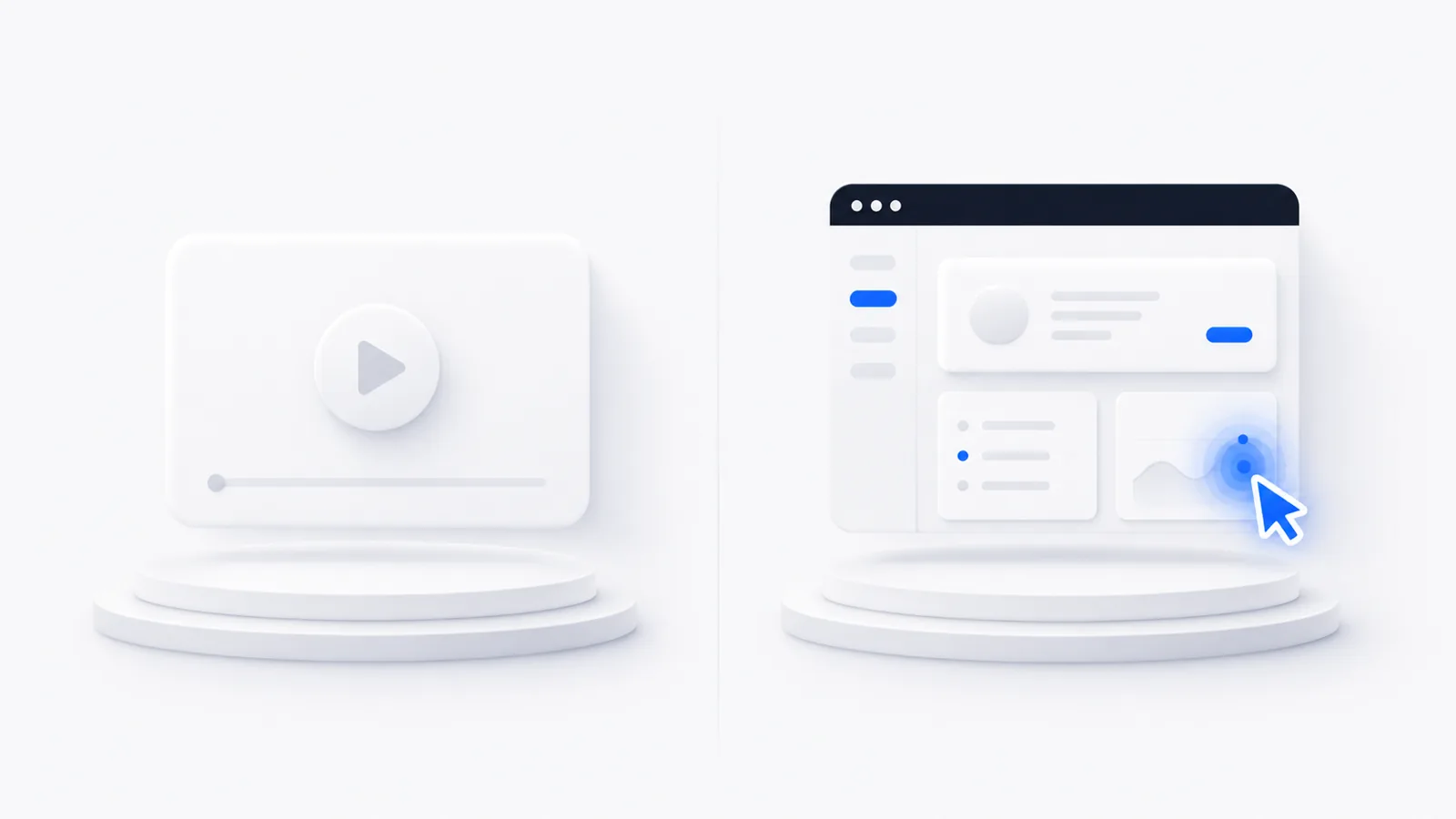
Every comparison post you'll find on this topic ends with "it depends." This one doesn't. There's a clear answer — and pretending otherwise is just avoiding the question.
The actual answer
Video wins for awareness. Interactive wins for conversion. That's it.
If someone has never heard of you and you want them to understand what you do in 60 seconds, a polished video is the better format. It works on LinkedIn, it works in ads, it works when you need to tell a story with motion and voiceover.
But if someone is evaluating you — reading your pricing page, following up on a cold email, sharing your product with their team — you want them clicking, not watching. An interactive demo gives them something to do. Clicking is a commitment. Watching is passive.
The test: would the person you're targeting share this with a colleague? A video gets forwarded once. An interactive demo gets forwarded with "you have to click through this."
Where video genuinely beats interactive
Video is better in specific situations, and pretending otherwise would be dishonest.
Social and paid ads
Interactive demos don't exist on LinkedIn or X. Video does. If you're running paid social, you have no choice — and a 30-second video with a clear hook is genuinely effective for first impressions.
Emotional or narrative content
Customer stories, founder videos, "why we built this" content — these work better as video. You can't replicate tone of voice or facial expression with a screenshot and a tooltip.
When the product involves motion
If your product's core value is in how something animates, how data flows in real time, or how a live feed updates — screenshots don't capture that. Video is the only honest way to demonstrate it.
Where interactive beats video — and it's not even close
For anything where the buyer is actively evaluating, interactive wins in almost every case.
Your website or pricing page
A video on your homepage asks the visitor to press play, sit back, and watch. An interactive demo invites them in. Visitors who self-select into clicking through a demo are already showing you something about their intent.
Post-call follow-up
After a discovery call, you send a video link and the prospect watches it alone. Or you send an interactive demo and they walk their CFO through it. Only one of those scenarios includes the person who controls the budget.
Technical or complex products
Engineers and product people want to explore on their own terms. They don't want to watch someone else click through a UI at someone else's pace. An interactive demo lets them skip straight to the part they care about.
The hidden cost most people ignore
Both formats require ongoing maintenance, but not equally. Your UI changes. Features get renamed. A button moves. A modal gets redesigned.
Updating an interactive demo takes minutes: swap a screenshot, reposition a hotspot. Updating a video means re-recording, re-editing, re-exporting, and re-uploading everywhere it lives. For fast-moving products, this isn't a small consideration. It's why a lot of teams record a video in month one and quietly let it go stale.
The practical answer
Use video for top-of-funnel content where you need reach and emotional impact. Use interactive demos from mid-funnel through close, where the buyer is doing their own research. If you can only do one: an interactive demo on your website moves more deals than a polished video that nobody watches twice.
Ready to pick a tool? See our best interactive demo software comparison.